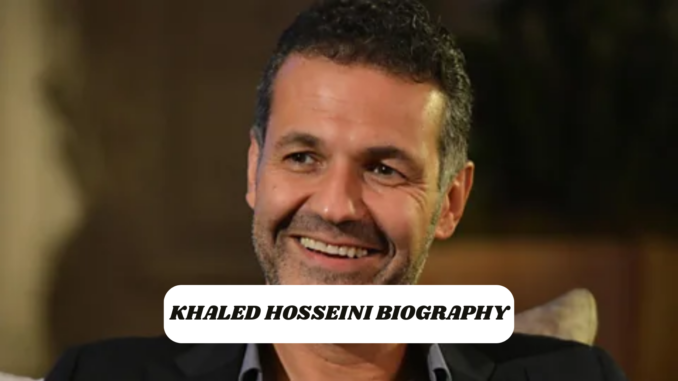
Khaled Hosseini is one of the most celebrated contemporary authors in the world, known for his emotionally powerful novels that explore themes of friendship, betrayal, redemption, family, love, and the devastating impact of war. His books, especially The Kite Runner, A Thousand Splendid Suns, and And the Mountains Echoed, have touched millions of readers globally and have been translated into dozens of languages. Hosseini’s writing is deeply influenced by his Afghan heritage and his personal experiences as an immigrant, making his work both intimate and universally relatable.
Born in Afghanistan and later settling in the United States, Khaled Hosseini’s journey from a medical doctor to a world-renowned novelist is nothing short of inspiring. His life story reflects resilience, cultural identity, and the power of storytelling to bridge worlds and foster compassion.
Early Life and Family Background
Khaled Hosseini was born on March 4, 1965, in Kabul, Afghanistan. He grew up in a loving, educated, and culturally rich family. His father worked as a diplomat in the Afghan Foreign Ministry, while his mother was a high school teacher. Because of his father’s diplomatic career, Hosseini was exposed to different cultures at a young age, an experience that later shaped his worldview and writing style.
In 1976, when Khaled was eleven years old, his family moved to Paris after his father was assigned to the Afghan Embassy in France. This move would change his life forever. While living abroad, Afghanistan was thrown into political chaos following the Soviet invasion in 1979. The Hosseini family could not return home safely and eventually sought political asylum in the United States.
In 1980, the family settled in San Jose, California. The transition from diplomatic comfort to refugee life was challenging. Hosseini has often spoken about how his family faced financial difficulties and cultural adjustments. Despite these hardships, his parents encouraged education and creativity, which laid the foundation for his future success.
Education and Medical Career
Khaled Hosseini attended high school in California and later enrolled at Santa Clara University, where he earned a degree in biology. Following his undergraduate studies, he pursued medicine at the University of California, San Diego School of Medicine, graduating in 1993.
He completed his residency in internal medicine at Cedars-Sinai Medical Center in Los Angeles. For several years, Hosseini practiced as a physician, working diligently while nurturing his passion for writing in his spare time. At that time, writing was not his profession but a personal outlet and creative pursuit.
Ironically, the discipline and structure of medical practice helped him develop the patience and focus needed for storytelling. His scientific background also added a level of precision and emotional depth to his narratives.
The Birth of a Writer
Khaled Hosseini began writing short stories inspired by his memories of Afghanistan. One of these stories later evolved into his first and most famous novel, The Kite Runner. Written while he was still practicing medicine, the novel took several years to complete.
Published in 2003, The Kite Runner became an international sensation. The book tells the story of Amir and Hassan, two boys growing up in Kabul, and explores themes of guilt, loyalty, betrayal, and redemption. Set against the backdrop of Afghanistan’s turbulent history, the novel offered many readers their first intimate glimpse into Afghan culture and humanized a country often seen only through the lens of war.
The success of The Kite Runner was overwhelming. It remained on bestseller lists for years, sold millions of copies worldwide, and was adapted into a major motion picture in 2007. This success marked the turning point in Hosseini’s life, allowing him to leave medicine and focus entirely on writing.
A Thousand Splendid Suns
In 2007, Hosseini released his second novel, A Thousand Splendid Suns. Unlike his first book, which centered on male friendship, this novel focused on the lives of two Afghan women, Mariam and Laila. The story portrayed their struggles, resilience, and courage in a patriarchal society torn apart by war and political oppression.
A Thousand Splendid Suns was widely praised for its emotional power and feminist perspective. It highlighted the strength of women and their capacity to endure unimaginable hardship. The novel became another global bestseller and is often regarded as one of the most moving books of the 21st century.
And the Mountains Echoed
In 2013, Hosseini published And the Mountains Echoed, a novel that expanded his storytelling style. Unlike his previous books, which followed a central narrative, this novel consisted of interconnected stories spanning multiple generations and countries.
The book explored themes of family, sacrifice, memory, and identity. It demonstrated Hosseini’s ability to experiment with narrative structure while maintaining his emotional depth and lyrical prose.
Sea Prayer
In 2018, Hosseini released Sea Prayer, a short illustrated book inspired by the tragic story of Syrian refugee children. This work was a heartfelt plea for compassion and understanding toward displaced people. It reflected his humanitarian commitment and his belief in the power of literature to inspire social change.
Humanitarian Work and Advocacy
Beyond literature, Khaled Hosseini is deeply committed to humanitarian causes. He serves as a Goodwill Envoy for the United Nations High Commissioner for Refugees (UNHCR). Through this role, he has traveled to refugee camps and conflict zones to advocate for displaced families and children.
He also founded the Khaled Hosseini Foundation, a nonprofit organization dedicated to providing humanitarian assistance to people in Afghanistan. The foundation supports housing, healthcare, education, and economic opportunities for vulnerable families.
Hosseini’s advocacy work is a natural extension of his writing. His stories give voice to the suffering and resilience of ordinary people, while his humanitarian efforts seek to improve their real-world conditions.
Writing Style and Literary Impact
Khaled Hosseini’s writing is known for its emotional honesty, vivid imagery, and powerful storytelling. He blends personal narratives with historical events, creating stories that feel both intimate and epic.
His novels are widely studied in schools and universities, praised for their cultural insight and universal themes. He has played a crucial role in shaping global perceptions of Afghanistan, portraying it as a land of rich culture, humanity, and resilience rather than just conflict.
Awards and Recognition
Over the years, Hosseini has received numerous awards and honors, including:
- Humanitarian awards for his advocacy work
- Literary awards for international fiction
- Recognition from human rights organizations
- Inclusion in lists of the world’s most influential authors
His books have sold over 40 million copies worldwide and have been translated into more than 70 languages.
Personal Life
Khaled Hosseini lives in Northern California with his wife and children. Despite his fame, he maintains a private lifestyle and remains deeply connected to his Afghan heritage. He frequently expresses gratitude for the opportunities he received and uses his platform to uplift marginalized voices.
Khaled Hosseini’s Influence on Global Literature
Khaled Hosseini’s influence on modern literature goes beyond bestseller lists and awards. He introduced millions of readers to Afghan culture, traditions, and emotional realities at a time when Afghanistan was mostly known in the media for war and instability. His novels shifted the narrative by showing the human side of the country—its families, friendships, love stories, and moral struggles.
Before Hosseini, Afghan voices were rarely represented in mainstream Western literature. His success opened doors for other writers from Afghanistan and similar regions to share their stories. Through his books, readers learned that behind every headline is a human story filled with hope, pain, and dignity.
His storytelling has helped promote empathy, cultural understanding, and compassion, making his work socially and politically impactful.
Themes in Khaled Hosseini’s Books
Hosseini’s novels are rich with recurring themes that resonate across cultures:
1. Redemption and Forgiveness
Many of his characters seek redemption after making life-altering mistakes. Amir’s journey in The Kite Runner is the most famous example, where guilt and responsibility drive personal transformation.
2. Family and Sacrifice
Family bonds, both biological and chosen, play a central role. Parents sacrifice for children, siblings protect one another, and love becomes a source of strength.
3. War and Its Consequences
Hosseini does not glorify war. Instead, he highlights how conflict destroys innocence, breaks families apart, and forces ordinary people into impossible choices.
4. The Strength of Women
A Thousand Splendid Suns stands as a tribute to Afghan women’s resilience. Hosseini portrays women as courageous, intelligent, and capable of extraordinary endurance.
5. Identity and Belonging
As an immigrant himself, Hosseini often explores the struggle of finding identity between two worlds. His characters grapple with loyalty to their roots while adapting to new cultures.
Adaptations of His Works
Khaled Hosseini’s novels have crossed into film and theater, expanding their reach even further.
- The Kite Runner was adapted into a film in 2007.
- It was also transformed into a stage play that premiered in London and later toured internationally.
- A Thousand Splendid Suns has been adapted into theatrical productions across different countries.
These adaptations demonstrate the timeless and universal appeal of his stories.
Khaled Hosseini and Education
Hosseini’s novels are widely included in school and university curricula. Teachers value his work because it:
- Encourages cultural awareness
- Promotes empathy and moral reflection
- Introduces students to global history
- Strengthens critical thinking skills
His books are often used in discussions about immigration, identity, human rights, and social responsibility.
Challenges and Criticism
Despite his success, Hosseini has faced criticism from some groups who believe his portrayal of Afghanistan focuses too heavily on suffering. However, Hosseini has explained that his intention is not to define Afghanistan by tragedy but to honor the resilience of its people.
He consistently emphasizes that Afghanistan is more than war—it is a land of poetry, beauty, tradition, and strong family values.
Legacy
Khaled Hosseini’s legacy is built on both literary excellence and humanitarian compassion. He is remembered not only as a storyteller but also as an advocate for displaced families and vulnerable children.
His books will continue to inspire future generations, reminding readers that kindness, responsibility, and courage can change lives.
FAQs
1. Who is Khaled Hosseini?
Khaled Hosseini is an Afghan-American novelist and humanitarian best known for The Kite Runner, A Thousand Splendid Suns, and And the Mountains Echoed.
2. When was Khaled Hosseini born?
He was born on March 4, 1965, in Kabul, Afghanistan.
3. What was Khaled Hosseini’s first profession?
Before becoming a full-time writer, he worked as a medical doctor specializing in internal medicine.
4. What is Khaled Hosseini’s most famous book?
The Kite Runner is his most famous and bestselling novel.
5. Why are Khaled Hosseini’s books so popular?
They combine emotional storytelling with historical context and universal themes like love, guilt, redemption, and family.
6. Is Khaled Hosseini involved in humanitarian work?
Yes. He is a UNHCR Goodwill Envoy and founder of the Khaled Hosseini Foundation.
7. How many books has Khaled Hosseini written?
He has written four major books:
- The Kite Runner
- A Thousand Splendid Suns
- And the Mountains Echoed
- Sea Prayer
8. Where does Khaled Hosseini live now?
He lives in Northern California, United States.
9. What makes Khaled Hosseini’s writing unique?
His ability to combine cultural authenticity, emotional depth, and simple yet powerful language.
10. What is Khaled Hosseini’s contribution to Afghan culture?
He introduced Afghan stories to a global audience, preserving cultural identity through literature.
Conclusion
Khaled Hosseini’s biography is a story of transformation, resilience, and purpose. From a young boy growing up in Kabul to a refugee in America, from a medical doctor to a world-renowned author, his journey reflects the power of perseverance and storytelling. His novels have changed how the world views Afghanistan and have reminded readers that humanity exists even in the darkest times.
Through his writing and humanitarian work, Hosseini has built a bridge between cultures, inspiring empathy and understanding across borders. His life and legacy stand as proof that stories can heal, educate, and unite people globally.
Leave a Reply