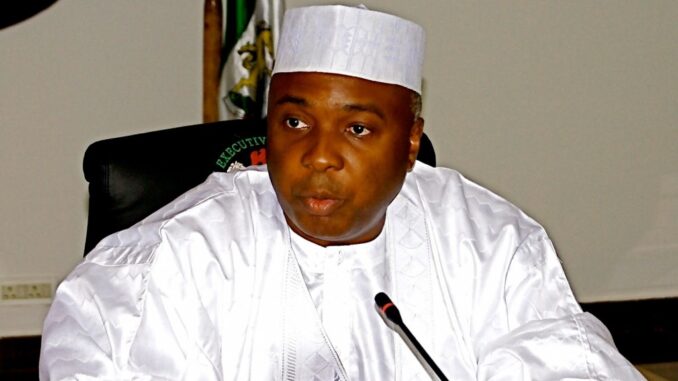
Bukola Saraki is one of the most influential and widely discussed political figures in modern Nigerian history. Known for his sharp intellect, reformist approach, and strong political heritage, Saraki has played a major role in shaping Nigeria’s legislative and political landscape. As a former Senate President of the Federal Republic of Nigeria and a two-term governor of Kwara State, his career spans executive leadership, legislative authority, and party politics at the highest levels.
This comprehensive Bukola Saraki biography explores his early life, education, political journey, achievements, controversies, and the legacy he continues to build in Nigerian politics.
Early Life and Family Background
Bukola Saraki was born on December 19, 1962, in London, United Kingdom. He hails from a prominent Nigerian political family. His father, Dr. Abubakar Olusola Saraki, was a powerful political figure in Nigeria, serving as a senator during the Second Republic and earning the title of Waziri of Ilorin. His mother, Florence Saraki, was a respected businesswoman and philanthropist.
Growing up in a politically active household exposed Bukola Saraki to leadership, governance, and public service from a very young age. This background played a significant role in shaping his interest in politics and national development.
Education and Academic Background
Bukola Saraki received a solid educational foundation both in Nigeria and abroad. He attended primary and secondary schools in Nigeria before moving overseas for higher education.
He earned a Bachelor’s degree in Geography from King’s College London. After completing his undergraduate studies, he furthered his education in the United States, where he obtained a Master of Business Administration (MBA) from the Kellogg School of Management at Northwestern University.
His international education equipped him with a global perspective on leadership, economics, and public administration, skills that later influenced his style of governance.
Early Career and Entry into Public Service
Before venturing fully into politics, Bukola Saraki worked in the private sector. He gained experience in banking and finance, including working with Société Générale Bank in Nigeria. His exposure to the financial sector gave him practical knowledge of economic management and institutional operations.
His formal entry into public service came in 2000 when he was appointed as the Special Assistant to the President on Budget under President Olusegun Obasanjo. In this role, Saraki played a part in shaping Nigeria’s budgeting and fiscal policy framework during a crucial reform period.
Political Career and Rise to Prominence
Governor of Kwara State (2003–2011)
Bukola Saraki’s major political breakthrough came in 2003 when he was elected Governor of Kwara State under the People’s Democratic Party (PDP). He was re-elected in 2007, serving two consecutive terms.
As governor, Saraki introduced several reforms in healthcare, education, agriculture, and infrastructure. One of his most notable initiatives was the health sector reform, which improved access to medical services across the state. He also focused on agricultural development, empowering farmers and promoting rural growth.
His tenure as governor earned him both praise and criticism, but it firmly established him as a key political force in Nigeria.
Senate Career and Senate Presidency
In 2011, Bukola Saraki was elected as the Senator representing Kwara Central Senatorial District. His influence in the National Assembly grew rapidly due to his experience and political strategy.
In 2015, Saraki made history when he emerged as the President of the Nigerian Senate. His emergence was politically significant, as it went against the preferred choice of his party leadership at the time. This move demonstrated his independence and ability to build cross-party alliances.
As Senate President from 2015 to 2019, Saraki presided over one of the most active legislative periods in Nigeria’s democracy. Under his leadership, the Senate focused on institutional reforms, electoral process improvements, and economic legislation.
Party Politics and Ideological Stance
Bukola Saraki’s political journey has involved multiple party affiliations. He began his political career in the PDP, later joined the All Progressives Congress (APC), and eventually returned to the PDP.
His party switches often generated debate, but Saraki has consistently described his actions as being driven by principles, internal party democracy, and national interest rather than personal ambition.
Ideologically, Saraki is often viewed as a centrist with reformist tendencies, advocating for stronger institutions, rule of law, and democratic accountability.
Controversies and Legal Battles
Like many high-profile politicians, Bukola Saraki’s career has not been without controversy. During his time as Senate President, he faced several legal challenges, including cases related to asset declarations.
These legal battles attracted national and international attention and were seen by supporters as politically motivated, while critics viewed them as part of Nigeria’s broader anti-corruption efforts. Eventually, Saraki was cleared of the major charges against him, a development that strengthened his political narrative of resilience.
Achievements and Contributions
Bukola Saraki has recorded several notable achievements throughout his career:
-
Two-term Governor of Kwara State
-
President of the Nigerian Senate (2015–2019)
-
Advocate for legislative independence
-
Promoter of health and agricultural reforms
-
Contributor to democratic development in Nigeria
Beyond elected office, he has been involved in policy discussions, leadership development, and mentorship of young politicians.
Personal Life
Bukola Saraki is married to Toyin Saraki, a public health advocate and philanthropist. The couple has children together. Despite his busy political life, Saraki is known to value family and often emphasizes the importance of balancing public service with personal responsibility.
Legacy and Influence in Nigerian Politics
Bukola Saraki’s legacy is defined by his bold political decisions, leadership roles, and ability to navigate complex political environments. Whether admired or criticized, his impact on Nigeria’s legislative and political history is undeniable.
He remains an influential voice in national discourse and continues to play a role in shaping the future of Nigerian democracy.
Frequently Asked Questions (FAQs)
Q1: Who is Bukola Saraki?
Bukola Saraki is a Nigerian politician, former Governor of Kwara State, and former President of the Nigerian Senate.
Q2: When was Bukola Saraki born?
He was born on December 19, 1962.
Q3: What position did Bukola Saraki hold in Nigeria?
He served as the 13th President of the Nigerian Senate from 2015 to 2019.
Q4: What is Bukola Saraki’s educational background?
He studied Geography at King’s College London and earned an MBA from Northwestern University.
Q5: Is Bukola Saraki still active in politics?
Yes, he remains active in Nigerian politics and national discussions.
Conclusion
Bukola Saraki’s biography reflects a life deeply connected to public service, leadership, and political evolution. From his early exposure to politics through his family to his rise as Senate President, Saraki’s journey is a testament to ambition, resilience, and influence. As Nigeria continues to evolve democratically, Bukola Saraki’s role in its political story remains significant and enduring.
Leave a Reply